75 years of television
On October 2, 2026, it will be exactly 75 years since the Netherlands’ first national television broadcast aired. A historic milestone with a distinctly Philips touch. Because did you know that television in the Netherlands didn’t start in Hilversum or Bussum, but in Eindhoven? Let’s dive into Philips’ television history!
For Philips, the television era begins at around the same time as radio. As early as 1925, the Philips Research Laboratory (NatLab) experiments with Nipkow discs, a photocell and a pioneering neon television lamp developed in-house. In 1928, the results are presented to the press and the public, and in the years that follow, advances in electronics and shortwave transmitters make it possible to improve picture quality.
Pioneering in the early years
Philips then decides to build an experimental transmitter. The company constructs several television sets, and in 1935, experimental trials begin in Eindhoven. Picture quality is continuously refined, and with 405 lines, the image is already considerably sharper than that of the very first ‘televisor’ from 1926, which had to make do with just thirty lines.
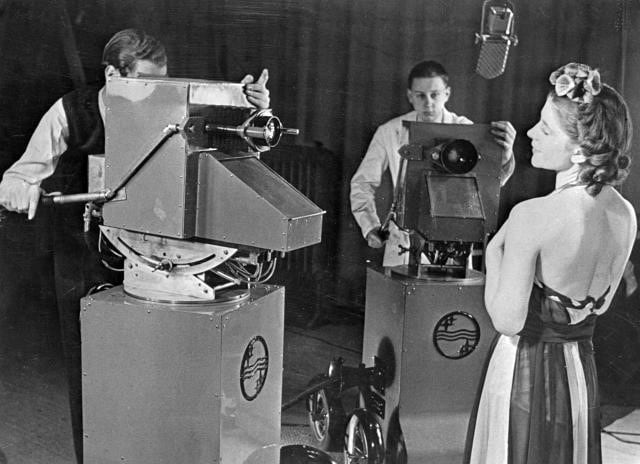
The company continues to push ahead, and in 1937 Philips increases the resolution to 567 lines. It is time to show the world what it has achieved. At the end of that year, Philips demonstrates this innovation at the Radiolympia exhibition in London, where many visitors see a television for the first time. Philips is on the verge of producing televisions on a large scale, but with the Second World War looming, these activities are scaled back.
World first with 625 lines
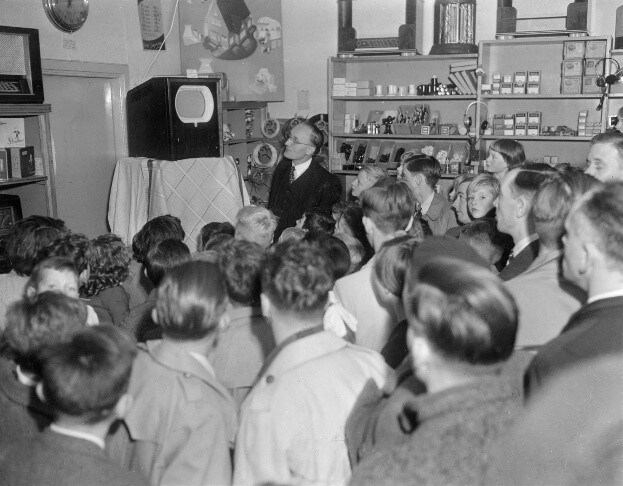
Immediately after the war, it is all hands on deck. In 1946, Philips begins preparations for experimental television broadcasts from Eindhoven. Two years later, a series of 264 broadcasts begins from the NatLab, with technicians, journalists and Philips employees watching in specially equipped viewing rooms. People also tune in at home, where a lucky few already have a television set, and in radio shops, witnessing these first, now-legendary broadcasts.
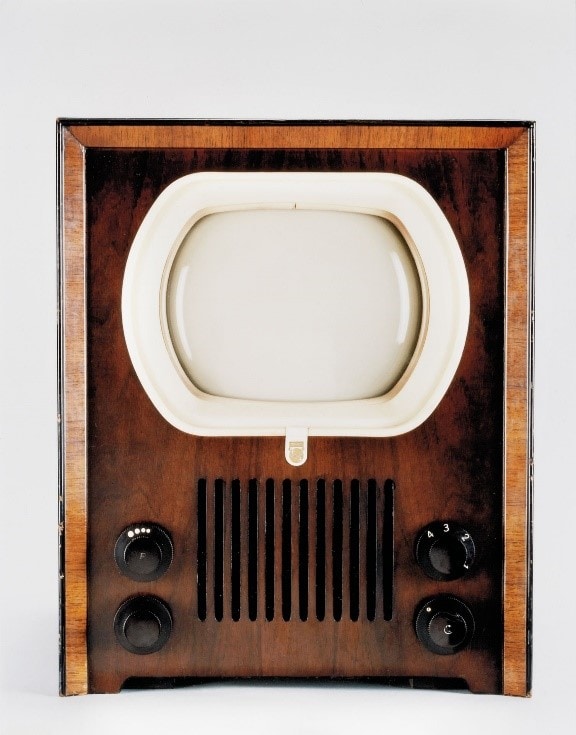
The reactions and reports? Positive. The picture and sound quality are considerably better than those of American and British television sets, and developments follow in rapid succession. In 1949, for example, more than two hundred doctors at Leiden University Hospital are able to watch a live broadcast of an operation being performed at another location. And in 1950, Eindhoven achieves a world first with the TX400U: the first television model with a 625-line picture and crystal-clear FM sound.
There is no turning back. Philips becomes a major player in a rapidly expanding market for television sets, picture tubes, television glass, cameras and electronic components. Where Philips had previously pioneered radio, it is now the picture tube that drives the company forward.
From bulky box to modern sixties model
It is not long before the first national television broadcast follows. The first television sets begin appearing in shops across Brabant, and Philips’ intensive lobbying of the government and radio broadcasters pays off. The company decides to convert a former church building in Bussum into a television studio. Most of the technicians working there are Philips employees who had gained experience with the experimental television transmitter.
On October 2, 1951, the moment finally arrives: the first national television broadcast goes on air from the newly renamed Irene Studio. On the program? A film about the making of carillon bells, an overview of the history of television and the play De Toverspiegel (The Magic Mirror). Initially, the five broadcasting associations, which have joined forces in the Nederlandse Televisie Stichting (NTS), broadcast for just three hours a week. At the time, there are only five hundred television sets in Dutch households.
But developments are moving fast, internationally as well. By 1960, television broadcasts can be received in fourteen of the seventeen Western European countries. The percentage of households with a television set has risen from six to thirty-five per cent. The television itself is also constantly being improved. Advances in pressed-glass technology and electronics have made screens larger, flatter and less curved. Picture tubes have also become shorter, allowing for shallower cabinets than the bulky sets of those pioneering early years.
Colour television
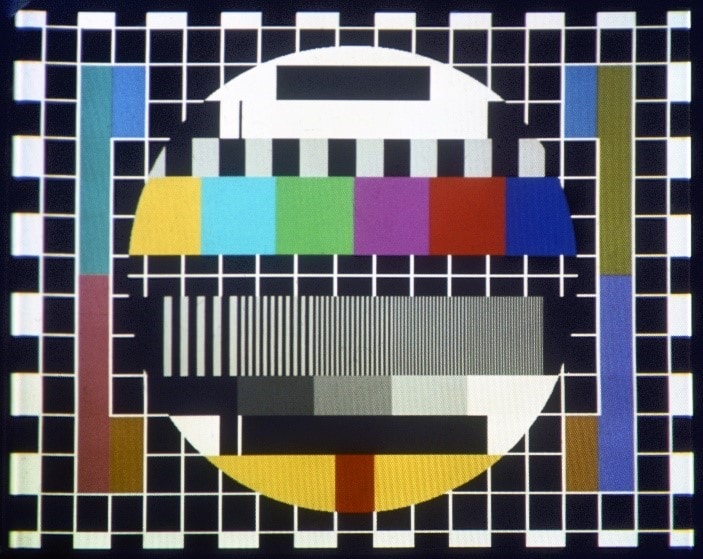
Amid all these rapid developments, attention soon turns to the next big thing: colour television. The first demonstrations take place in the mid-1950s, with the world’s first large-screen colour television projection via cable as an early highlight. In 1956, Philips demonstrates to the international advisory committee CCIR how far it has progressed with broadcasting colour television over the air. From camera to receiver, Philips has developed the entire system in-house.
In 1962, Canada buys up Philips’ entire stock of color television sets, which are shipped across the Atlantic two years later. Around the same time, Philips begins experimental color broadcasts, and in 1964 Eindhoven becomes the first European city to air color television broadcasts once a month. For three years, Eindhoven remains the only city in the Netherlands with its ‘own’ color television broadcasts, but by 1967 the rest of the country is ready for the color revolution.
The complete viewing experience with HDTV and Ambilight
Since the early 1970s, Philips has continued to push the boundaries of picture quality, digital technology and innovative features. The arrival of advanced HDTV ushers in a new era of television, and Philips is quick to respond, joining forces with France’s Thomson to develop a European standard for HDTV broadcasts via satellite. With razor-sharp images and digital sound, the cinema experience at home comes one step closer to reality. Innovations such as Ambilight, which casts a glow behind the television that follows the colors and brightness of the images on screen, also demonstrate how Philips aims to immerse viewers in a complete viewing experience.
From picture tube to image processing
For decades, television is one of the products that defines Philips. But times and markets change, and in 2011 Philips announces its decision to exit the television market. The company sells its television business to TP Vision, which continues to develop and market televisions under the Philips brand.
The decision to largely end its television activities marks a significant moment in Philips’ history. But that does not mean Philips has left the screen behind for good. The company continues to play a pioneering role in developing imaging technologies for healthcare. The innovative spirit that once drove Philips’ advances in picture tubes lives on today in imaging systems for hospitals and other healthcare institutions.
75 years of television at the Philips Museum
From October 2 to 16, celebrate 75 years of television at the Philips Museum. Discover how television evolved from a technological breakthrough into an indispensable part of everyday life. Attend fascinating mini-lectures and learn all about the technology behind picture and sound. Visitors of all ages can enjoy fun activities, interactive challenges and surprising discoveries, including a special mini-exhibition celebrating 75 years of television.
An inspiring day out for curious minds, makers and families. Come and see, learn and experience it for yourself! On the weekend of October 2 and 3, admission to the museum is free for everyone.
Read more about the pop-up exhibition 75 Years of Television here.

