Met Philips BlueSeal MRI werken aan meer kostbare herinneringen
dec 08, 2025 | 3 minuten leestijd
“Bijna iedereen kent wel iemand, een familielid, vriend of kennis, die leeft met Alzheimer.” Met die woorden opende Nadine Reijnders, Clinical Product Management Leader MRI bij Philips, haar verhaal over hoe innovaties in MRI bijdragen aan de strijd tegen deze ingrijpende ziekte. Ze presenteerde haar verhaal tijdens de opening van het hoofdkantoor van Philips als een van de Innovation Stories.

Alzheimer raakt miljoenen mensen wereldwijd, als patiënt of als mantelzorger. En dat aantal neemt snel toe. In 2050 zullen naar verwachting bijna 90 miljoen mensen met de ziekte leven. Een genezing bestaat nog niet, maar nieuwe behandelingen, betere monitoring en nauwere samenwerking tussen zorgorganisaties geven patiënten de kans om langer stabiel te blijven en meer waardevolle tijd door te brengen met hun dierbaren.
De rol van MRI bij behandeling van Alzheimer
Een belangrijke doorbraak in de behandeling van Alzheimer is de komst van nieuwe medicijnen, de zogenoemde monoklonale antilichamen. Deze breken eiwitophopingen in de hersenen af die worden gezien als een belangrijke veroorzaker van de ziekte. Door die af te breken, kan het proces van cognitieve achteruitgang worden vertraagd. “Maar deze behandeling werkt het beste als je er op tijd bij bent”, legt Nadine uit. “Vroege diagnose is dus cruciaal.”
Lees hier meer over Philips BlueSeal Horizon: ‘s werelds eerste heliumvrije 3.0T MRI-platform [2]
En daar komt MRI om de hoek kijken. In combinatie met cognitieve testen en bloedonderzoek helpt Philips BlueSeal MRI om Alzheimer eerder te herkennen. En zodra een patiënt met medicatie wordt behandeld, blijft monitoring essentieel. Artsen willen zeker weten dat er geen bijwerkingen optreden, zoals kleine hersenbloedingen die alleen zichtbaar zijn op een MRI-scan.
Minder helium, meer mogelijkheden
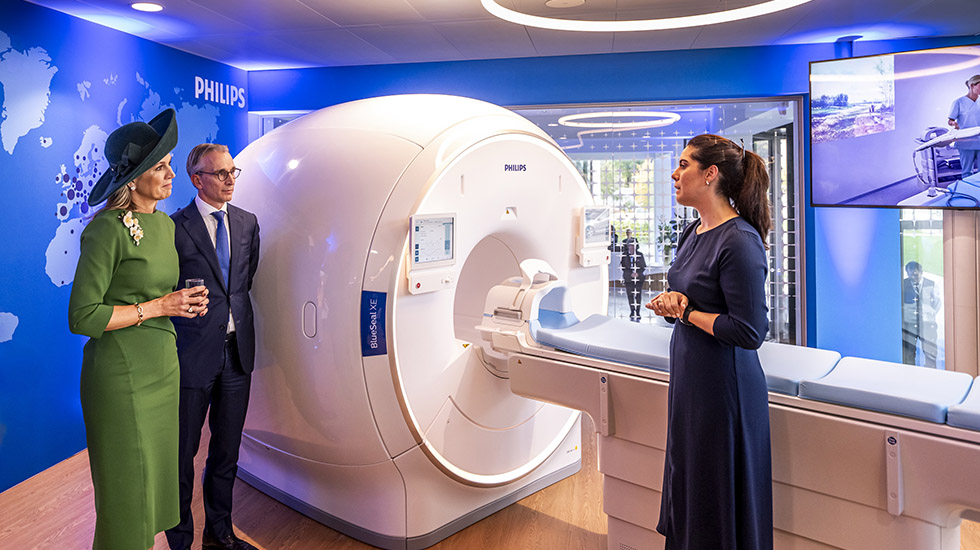
Toch is toegang tot MRI nog niet vanzelfsprekend. In veel delen van de wereld zijn er te weinig scanners, of zijn ze te duur om te plaatsen en te onderhouden. Daarom ontwikkelt Philips slimme oplossingen die zorg toegankelijker maken voor meer patiënten wereldwijd. Philips BlueSeal MRI bevat een kleine hoeveelheid helium die hermetisch is afgesloten in het systeem en heeft dus geen constante aanvoer nodig. Daardoor is het systeem niet alleen duurzamer, maar ook lichter en eenvoudiger te plaatsen op uiteenlopende locaties binnen ziekenhuizen en zorgcentra wereldwijd.
Een andere innovatie is BlueSeal Mobile, de eerste heliumvrije [1] MRI op wielen. Het systeem biedt dezelfde technologie, maar kan worden ingezet op plekken waar patiënten anders geen toegang zouden hebben tot deze vorm van zorg.
Een betere patiëntervaring
Naast betere toegang tot zorg richt Philips zich ook op de patiëntervaring. “Een MRI-scan kan voor veel mensen stressvol zijn, zeker voor mensen die leven met Alzheimer”, zegt Nadine. “Daarom is het belangrijk dat we technologie ontwikkelen die ook emotionele ondersteuning biedt.” De scanner is uitgerust met Ambient Experience, een combinatie van rustgevende verlichting, geluid en visuals die helpen om angst te verminderen en de ervaring prettiger te maken.
Philips werkt ook aan het versnellen van scanprocessen. Nadine legt uit: “Door AI-software in te zetten om scans te plannen en te versnellen, kunnen we patiënten tot drie keer sneller scannen of met een hogere beeldkwaliteit. Daardoor kunnen ziekenhuizen en zorginstellingen meer mensen helpen en nauwkeurigere diagnoses stellen.”
Nederlandse samenwerking als voorbeeld
Een bijzonder project dat laat zien hoe technologie zorg toegankelijker maakt, is de samenwerking met Het Zonnehuis in Doorn en het Radiology Operations Command Centre van UMC Utrecht. In deze samenwerking is een Philips MRI geplaatst in het Zonnehuis, waar zorgverleners via een beveiligde verbinding hulp kunnen inschakelen van radiologen en MRI-specialisten in Utrecht.
Met één klik kan een lokaal opgeleide zorgverlener ondersteuning krijgen bij het uitvoeren van complexe scans. De patiënt hoeft daardoor niet te reizen, want de zorg komt naar hem of haar toe. “Dit project laat zien hoe zorg slimmer en menselijker kan worden ingericht”, zegt Nadine. “En het biedt kansen om patiënten ook op langere termijn te volgen tijdens hun behandeling.”
Meer tijd en meer herinneringen
Innovaties binnen MRI laten zien dat technologie niet alleen het verschil maakt in diagnostiek, maar ook in beleving, toegankelijkheid en kwaliteit van leven. Want bij Alzheimer gaat het uiteindelijk om tijd. Tijd om de juiste behandeling te starten. Tijd om rust en comfort te bieden. En vooral: tijd om herinneringen vast te houden.
“Wat we vandaag laten zien, is slechts een glimp van wat er mogelijk is”, besluit Nadine. “Samen met onze partners blijven we werken aan oplossingen die meer mensen helpen, betere zorg bieden en die mensen meer kostbare herinneringen teruggeven.”
Disclaimer [1] Heliumvrije werking: 7 liter helium is permanent ingesloten in het cryogene circuit.
[2] 3.0T BlueSeal Horizon is “Work in Progress” en niet beschikbaar in enig rechtsgebied. Het is niet te koop in de VS. De toekomstige beschikbaarheid kan niet worden gegarandeerd.
Creating more precious memories with Philips BlueSeal MRI
“Almost everyone knows someone — a family member, friend, or acquaintance — who is living with Alzheimer’s.” With those words, Nadine Reijnders, Clinical Product Management Leader MRI at Philips, opened her story about how innovations in MRI are helping in the fight against this devastating disease. She presented her story during the opening of Philips' headquarters as one of the Innovation Stories.

Alzheimer’s affects millions of people around the world, both patients and caregivers. And that number is rising rapidly. By 2050, nearly 90 million people are expected to be living with the disease. There is no cure yet, but new treatments, better monitoring, and closer collaboration across healthcare organisations are giving patients the chance to remain stable for longer and spend more valuable time with their loved ones.
The role of MRI in treating Alzheimer’s
A major breakthrough in Alzheimer’s treatment is the arrival of new medicines known as monoclonal antibodies. These break down protein deposits in the brain that are believed to be a key cause of the disease. By doing so, they can slow the process of cognitive decline. “But this treatment works best when it’s started early,” Nadine explained. “Early diagnosis is therefore crucial.”
That’s where MRI treatment comes in. In combination with cognitive testing and blood analysis, Philips BlueSeal MRI helps to detect Alzheimer’s at an earlier stage. Once a patient starts medication, ongoing monitoring remains essential. Physicians need to ensure there are no side effects, such as small brain bleeds that can only be detected through an MRI scan.
Read more about Philips BlueSeal Horizon: world’s first helium-free 3.0T MRI platform [2]
Less helium, more possibilities
Yet access to MRI is still far from universal. In many parts of the world, there are too few scanners, or they are too expensive to install and maintain.
That’s why Philips develops smart solutions that make care more accessible to more patients around the world. Philips BlueSeal MRI has a small amount of helium sealed in the machine and does not require a constant supply of helium. Making it not only more sustainable, but also lighter and easier to stall in a wider variety of locations within hospital walls and in healthcare centers around the globe.
Another innovation is BlueSeal Mobile, the first helium-free [1] MRI on wheels. It offers the same technology but can be deployed in areas where patients would otherwise not have access to this type of care.
Read more about the partnership between Philip and Cortechs.ai to advance quantitative neuroimaging
Improving the patient experience
Next to improving the access to care, Philips also focuses on improving the patient experience. “A scan can be stressful for many people, especially for those living with Alzheimer’s,” Nadine says. “That’s why it’s important to design technology that also provides emotional support.” The MRI system features Ambient Experience, a combination of calming light, sound, and visuals designed to reduce anxiety and create a more pleasant experience.
Philips also works on speeding up the scanning process. Nadine explains: “By applying AI software to plan and accelerate scans, we can scan patients up to three times faster or with higher image quality. This allows hospitals and care facilities to help more people and deliver more accurate diagnoses.”
Dutch collaboration as an example
A remarkable project that demonstrates how technology can make care more accessible is the collaboration between Het Zonnehuis (a rehabilitation center) in Doorn and the Radiology Operations Command Centre of UMC Utrecht. In this partnership, a Philips MRI has been installed at Het Zonnehuis, where local caregivers can securely connect with radiologists and MRI specialists in Utrecht.
With a single click, locally trained staff in Doorn can receive guidance during complex scans. As a result, patients no longer need to travel. Care comes to them instead. “This project shows how care can be organized in a smarter and more human way,” Nadine says. “It also creates opportunities to follow patients over a longer period during their treatment.”
More time, more memories
Innovations in MRI show that technology can make a difference not only in diagnosis, but also in patient experience, accessibility, and quality of life. Because when it comes to Alzheimer’s, it all comes down to time. Time to start the right treatment. Time to provide comfort and peace of mind. And above all, time to hold on to memories.
“What we are showing today is only a glimpse of what’s possible,” Nadine concludes. “Together with our partners, we continue to create solutions that help more people, deliver better care, and give them more precious memories to keep.”
Disclaimer [1] Helium-free operations. 7 liters of helium is permanently enclosed in the cryogenic circuit.
[2] 3.0T BlueSeal Horizon is ‘Work in Progress’ and not available in any jurisdiction. It is not for sale in the USA. Its future availability cannot be ensured.
Voor meer informatie

Contact informatie Contact informatie

You are about to visit a Philips global content page
Continue